

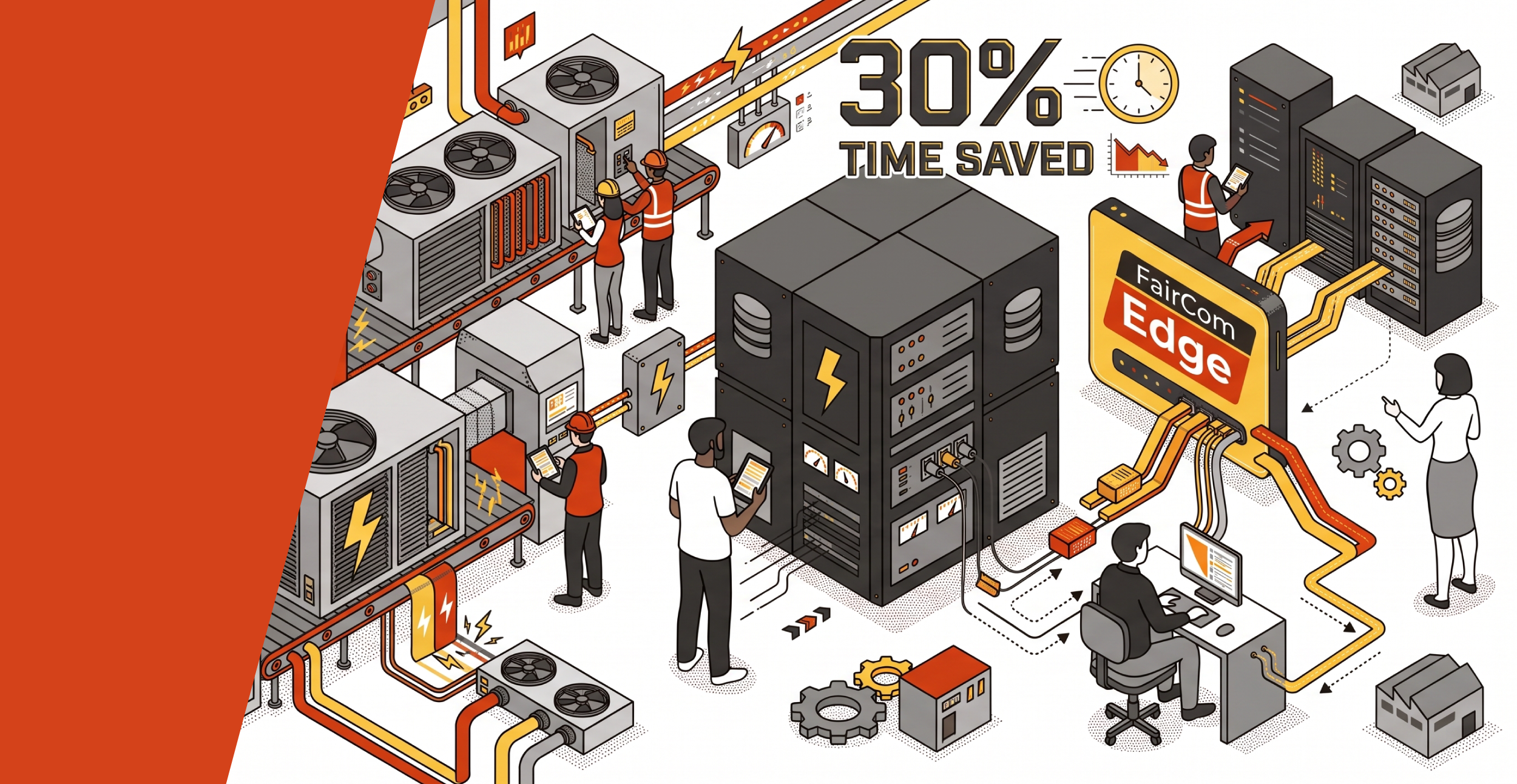
“At least 30% of the job—the time that I was spending cleaning the data—was gone. It was huge. You can’t believe how much you’ve made my life easier right now.”
— Shahram Hanifi, Senior Data Scientist, M-ACE
The Challenge
Fragmented data streams, legacy equipment, and protocol silos forced data scientists to spend nearly a third of their time cleaning raw factory telemetry.
Our Solution
By deploying FairCom Edge as a central platform for collecting, integrating and storing industrial data, M-ACE reduced the time required for manual data preparation, allowing more time to be focused on analysis and identifying energy-saving opportunities.
Outcome
- Reduced time spent on manual data cleaning and preprocessing by approximately 30%
- Supported the identification of multiple energy-saving opportunities within two months of deployment
- Projected 10% to 20% total reduction in energy consumption over the next year or so
Mitsubishi Electric is a global manufacturing giant in electrical and electronic systems, generating $37.45 billion in annual revenue. Its subsidiary Mitsubishi Electric Air Conditioning Systems Europe Ltd. (M-ACE), located in Livingston, Scotland, focuses on producing climate control systems for international markets.
To maintain peak operations while driving sustainability goals, M-ACE relies on Senior Data Scientist Shahram Hanifi to extract actionable intelligence from the shop floor. Hanifi, who has authored academic research on wind power forecasting, predictive maintenance modeling, and energy consumption in smart factories, develops M-ACE’s smart factory and digital transformation initiatives.
The Challenge
Protocol siloes, fragmented data, and time-consuming pre-processing
Industrial manufacturing facilities require massive electrical input to maintain continuous operations, making energy optimization a key cost-saving strategy for factories. However, identifying high-energy-consuming equipment among thousands of industrial assets means sifting through a diverse array of data formats.
Even comparing data points can become a Herculean task as data scientists desperately try to close the gaps across a sprawling tech stack. Telemetry spanning power meters, air flow, temperature, and vibration sensors is often split across disjointed systems.
“If they have a lot of sensors, devices, machines with different communication protocols, they need just one platform," Hanifi says. “They need FairCom Edge.”
M-ACE’s operations require multiple industrial communication protocols within the same environment. Prior to FairCom Edge, data from different sensors and systems was collected through separate platforms and methods, making integration and standardization more challenging. In some legacy and test data collection arrangements, issues such as mismatched timestamps, sequencing errors, and inconsistent data formatting required additional manual preprocessing before the data could be reliably analysed.
“In some cases, data was recorded to the wrong columns—I needed to spend a lot of time pre-processing and cleaning the data,” says Hanifi. “With FairCom, you don’t have that problem.”
These disjointed systems required intensive manual debugging to find and correct sequencing errors. Without a reliable integration layer, data formatting and reprocessing consumed roughly 30% of the time Hanifi spent on a project, creating a major bottleneck in his analytics workflow. In addition, storage limitations on legacy platforms often meant data could only be retained for two years, restricting the company’s ability to analyze long-term historical trends.
The Solution
A unified automated data integration layer
To eliminate protocol barriers and automate standardizing incoming telemetry, M-ACE deployed FairCom Edge as a central data platform connecting the plant’s energy meters. It acts as a high-performance superhighway bridging the shop-floor machines and sensors with downstream analytics.
“With FairCom Edge, in just one central platform you can connect to all of those sensors, machines, and devices, and collect your data,” Hanifi says.” “That’s one of the most important capabilities of FairCom Edge.”
Once configured, FairCom Edge automatically collects data at the specified interval, sequencing and timestamping all incoming data. Scaling the solution proved incredibly efficient; Hanifi noted that after configuring the first sensor, his team was able to connect hundreds of subsequent sensors in only a day or two.
“That’s enough. You don’t need to be worried about the data collection process. You’re 100% sure that raw data will be collected and stored in that data server,” Hanifi says.
For high-frequency equipment, like vibration sensors capturing multiple readings per second, FairCom Edge’s aggregation engine automatically computes minimum, maximum, and average values. This drastically reduces the data footprint before storage within FairCom Edge’s embedded database or transmission via its MQTT broker, maintaining trend fidelity while preventing downstream dashboards from being overwhelmed.
The Outcome
Time Saved, energy saved, budget saved
With the data automatically collected, standardized, and stored locally, FairCom Edge freed up Hanifi’s time for higher-level work—and he put it to good use. M-ACE connected FairCom Edge to Power BI via ODBC for interactive dashboards and to Jupyter Notebooks via Python for data analysis.
”At least 30% of the job—the time that I was spending cleaning the data—was gone. It was huge.”
This streamlined pipeline brought immediate productivity gains. “The pre-processing step is just completely eliminated,” Hanifi tells us. “At least 30% of the job—the time that I was spending cleaning the data—was gone. It was huge. You can’t believe how much you’ve made my life easier right now.”
Freed from fighting data, Hanifi could focus on improving business outcomes. Within two months of collecting data, M-ACE identified tens of opportunities for energy-saving adjustments across the shop floor. Hanifi predicts these opportunities will lead to a 10% to 20% total reduction in M-ACE’s energy consumption over the next year or two, and M-ACE is deploying FairCom Edge to additional devices.
“I relied on the platform, and I told our managers that we can trust this platform,” Hanifi says. “We can expand its use and bring more of our data into one central platform.”
In the meantime, FairCom Edge continues to keep M-ACE data secure in its native database, allowing the team to retain more historical data and improving long-term trend analysis and predictive maintenance.
"I would strongly recommend using FairCom in any industrial environment. If they have a lot of sensors, devices, machines with different communication protocols, they need just one platform, Hanifi concludes. “They need FairCom Edge.”


